Friday, 29 May 2015

Canberra Autumn Mushroom Soup


It seems that for most people who live in Canberra, autumn is a favourite season. A time of cooler temperatures; a reprieve from the often unrelenting heat of a long dry summer, and a change to clear, crisp, sunny days. A time of softer light, and of course, the turning of the leaves from summer green through an almost surreal palette of vibrant yellows, reds, and oranges.

Autumn in Weston Park, Canberra, 18 April 2015.
Manchurian Pear leaves, 13 April 2015.
Japanese Maple leaf, 8 May 2015.
Fallen oak leaves, 18 April 2015.

But for me, while all of this is true, it is also underlain with the inevitability that the brief tapestry of brilliant autumn colours will all too soon be replaced with a drear treescape of gaunt grey and brown skeletons, and more depressingly, the foreboding knowledge of the imminent onset of Canberra’s cold winter months. I dread the slow dying of summer. And look keenly to the onset of spring’s re-birth as soon as the winter solstice passes - somewhat prematurely given the coldest months are still to come.

I just prefer heat to cold!


*  *  *


Another less obvious feature of a Canberra autumn is the sudden appearance of a variety of mushrooms, a flush of fungal exuberance in the wake of recent rains, in a landscape otherwise in seasonal decline. They might appear almost anywhere: in the parklands, woodlands and forests, in patches of lawn, along roadside verges, and almost anywhere garden mulch has been applied.

Tiny unidentified mushrooms pushing through eucalypt mulch in our front garden, 26 April 2015. 

While I’m interested in mushrooms, I really am not very good at identifying them. There are a small number of edible ones that I am sufficiently comfortable not only to identify but even to eat, however these tend to be non-native species that have been introduced, generally from Europe, and are well known both historically and gastronomically. These include the standard field mushroom Agaricus campestris (and a couple of close relatives), the shaggy cap Coprinus comatus, the saffron milk cap or red pine mushroom Lactarius deliciosus (the name says it all), and a small caramel-coloured mushroom that springs up in fairy rings in lawns, Marasmius oreades.


One of the first I noticed this year was definitely not one to eat though - a small cluster of classic ‘toadstools’, the red and white speckled fly agaric or Amanita muscaria.  These were in a small garden area beside the footpath along Marcus Clark Street, beside Ian Potter House (once Beauchamp House) in the middle of Canberra City. And, not surprisingly, they were in the mulch beneath an oak tree. While not as poisonous as the death cap Amanita phalloides, this mushroom contains several pharmacological and psychoactive compounds which are definitely not worth messing around with.

The fly agaric Amanita muscaria - the classic red & white 'toadstool' that occurs under oak trees. 17 April 2015.
The fly agaric has bright white gills underneath.
Despite being poisonous (to humans), this fly agaric is apparently being enjoyed by a slug.


During a walk through Weston Park, on the other side of the lake, I came across a few other types of mushroom. The first was possibly some type of agaric but I’m really not sure. Although I wouldn’t eat them, they were certainly of great appeal to a range of invertebrates, including several millipedes, and at least four different types of fly. In fact they were looking pretty fly-blown and ratty.

A quiet corner of Lake Burley Griffin in autumn from Weston Park, 18 April 2015.

Some type of agaric? Certainly enjoyed by many small critters, 18 April 2015.

Millipedes were seen on several of the mushrooms.

One type of fly, of which there were at least half a dozen individuals, would settle on the cap of the mushroom for a while, then fly a short distance away and trace out a rapid erratic triangular path on the flat exposed blade a fallen eucalypt leaf. Only the palest (brightest in the weak sunlight) leaves seemed to be selected. It was quite bizarre to see several of these flies, in reasonable proximity to the mushrooms and to each other, darting about on their chosen leaves like some sort of animated Spirograph doodle bugs (remember Spirograph?).

Unidentified fly, torn between mushroom and eucalypt leaf. 18 April 2015.

...and in blurry close-up.


There were also flies that looked like they were from the family Dolichopodidae, and possibly Sepsidae, as well as several Heleomyzid flies (I think) which were probably the most possessive of all about their mushrooms.

A Dolichopodid fly (?) on an agaric mushroom, 18 April 2015.
Possibly a Sepsid fly on an agaric, 18 April 2015.

A mushroom fly (Heleomyzidae) on an agaric. 18 April 2015.
These mushroom flies (Heleomyzidae) seemed quite possessive of their mushrooms. 18 April 2015.
They would battle it out if two of them happened to cross paths atop the mushroom cap. 18 April 2015.

Further along, I came across several clusters of a type of bright yellowish-brown mushroom that appeared only to grow on the cut stumps of pine trees (probably Pinus radiata, but there are several other Pinus species included in the plantings along the lake between Warrina Inlet and Nursery Bay). No idea what these are, but they’re cute.

Unidentified mushrooms on Pinus stump, 18 April 2015.
They always grew in tight clusters.
And had the typical gills possessed by most mushrooms.

Then, in some well kept lawns I came across a band of Boletus mushrooms, just one small arc at the circumference of a would-be fairy ring that must have had a diameter of about 30 metres or more. Fairy rings are produced as the underground mycelium (the fine thread-like hyphae) of the fungus grow and spread out radially from a central point, the fruiting bodies (the mushrooms) emerging around the circumference or part thereof, of the actively growing fungus while the inner parts progressively die off. The under-surface of the cap of Boletus mushrooms is characterised by having pores rather than the gills that most mushrooms have.

A species of Boletus, growing as part of a fairy ring in Weston Park, Canberra, 18 April 2015.
Boletus has pores rather than the more usual gills.
Pores of a Boletus mushroom in close-up, 18 April 2015.

A week or so later, while walking back to the car from work, I espied a clump of Agaricus mushrooms, possibly campestris, possibly something else closely related, from a footbridge over Parkes Way. I immediately back-tracked and picked them. They definitely weren’t Agaricus xanthodermis, the yellow stainer, which is similar-looking but slightly poisonous, so I felt comfortable eating them. That night, I prepared a simple mushroom soup using the remains of a roast chicken carcass for stock and adding the mushrooms, a few herbs from the garden, and a dash of cream. I get a real buzz out of making great food from simple wild produce.

Field mushrooms picked on the way home from work - the basis for a great mushroom soup - 30 April 2015.
Field mushrooms - chopped and ready for the pot.
Yum!

Another week later, in almost the exact same spot and under almost identical circumstances, I gathered a paper bag full of shaggy caps Coprinus comatus (also known as ink caps, shaggy mane or lawyer’s wig mushroom). These are undoubtedly my favourite wild mushroom, but you have to get onto processing them quickly because within a short time of picking, or if left in the field for that matter, they will essentially dissolve through a process called autolysis to a sticky black liquid mess.

Shaggy caps are absolutely delicious - they have an intense ‘mushroomy’ flavour and are perfect for adding to stews or (if not too advanced) simply sautéing briefly with butter and having as a side on toast with eggs and bacon for breakfast. I recall one time when we were on holiday, coming across some shaggy caps in Kingston SE in South Australia during an early morning walk. It took a little persuasion to get Karen to join me in having them for breakfast that morning, but she’s been a convert ever since. 


Shaggy caps, or lawyer's wigs, on the chopping block. 7 May 2015.
These shaggy caps are a little more advanced and on the verge of autolysing.
Shaggy caps sliced down the middle - the cap is only loosely attached to the top of the stalk.

On slicing the mushrooms I noticed what at first I thought were flecks of dirt - but they were moving! A closer look revealed that they were in fact tiny collembolans. Collembola is a class of arthropods, not quite insects but related to them, and referred to as entognathous hexapods (along with two other groups the Protura and Diplura). Even though they are extremely common in soil and vegetative matter, because they are so tiny (these were no more that a millimetre in length) this was the first time I'd ever knowingly noticed collembolans (though I had used similarly 'dirty' mushrooms in the past).


Tiny collembolans, only a mm or so in length, infested the inside of the hollow stalk of the shaggy caps.

But I wasn't about to let a little additional protein from the collembolans get in the way. On this occasion, with a bit of a mix of young and not so young specimens, I simply cooked them all up briefly in a frying pan with a little butter and a splash of water, then froze them in an ice cube tray, to be used as required through the encroaching cold dark Canberra winter evenings…


PS. If anyone knows the identity of any of the mushrooms or flies that I don't, or thinks I've misidentified others, please leave a comment. I hate the thought of wrong information being published and perpetuated on the web and will gladly correct any errors I may have made.


Sunday, 26 April 2015

Tarago Railway Station


Tarago is a small village in the Southern Tablelands of New South Wales. At the time of the last census (2011) it had a population of 351 - and falling. 

It has a beautiful little railway station. 


Tarago railway station has an 84 metre platform, with a dock at the down end of the station
and a stock siding at the up end.

Tarago is on the Goulburn - Braidwood Road. I've never traveled between Goulburn and Braidwood, in either direction. But it is also on an alternative route I sometimes take to the coast, which goes from Canberra, through Bungendore and Tarago before heading across to Oallen Ford, Nerriga and Sassafras and finally heading down the escarpment to Nowra. When passing through Tarago I've often thought I should stop and have a look at the railway station - I like old railway stations for some reason (see an earlier post on derelict Girilambone railway station in outback NSW). A week or so ago I finally got my chance.


The Tarago railway station is in great condition, and has recently been meticulously repainted. It looks stunning. It seems to be shut up most of the time, but there are still three TrainLink Explorer services operating daily between Sydney and Canberra which pass through Tarago.

The station was first opened on 3 January 1884 and was the terminus of the line before it was pushed through to Bungendore 14 months later. Tarago has two other old buildings of note: St Josephs Catholic Church, and the Loaded Dog Hotel which dates from 1848. Lunch and lager at the latter was the real reason we were in Tarago on this occasion.


The area around Tarago was already occupied by the Ngunnawal people, and well known to other tribes which traversed the area to the coast or the Monaro during bogong moth season, when the first European explorers came to the area. 

Surveyor General James Meehan, with a then young and relatively inexperienced Hamilton Hume as a junior member of the team, was leading part of an 1818 expedition commissioned by Governor Macquarie, when they discovered the nearby Lake Bathurst, an ephemeral lake that at the time happened to be full, with abundant birdlife and lush grasslands. Prospects seemed good and the area was settled during the 1820s, initially at a station called Waterloo Plains, followed by the establishment of two small villages, Lake Bathurst and Tarago. 

In fact the present tiny village of Lake Bathurst, 7 kilometres north of Tarago, was the original Tarago, and the current village of Tarago was initially known as Sherwin's Flats. One story has it that there was a mix up of names when the railway line came through: "Apparently, when the maps of a new railway line were being transcribed, the two village names were inadvertently reversed, By the time the mistake was realized, the drafts had already been sent to England for printing and returned. A local railway Inspector decided it was more prudent to change the village names, than to reprint all the maps."  * 


The name Tarago is thought to mean 'country', or possibly 'a place between two bodies of water' in the Ngunnawal language (the other body of water being Lake George, about 20 kilometres to the west). Lake Bathurst, named by Meehan in 1819, and the village, are both named after Earl Bathurst who, at the time, was the British Secretary of State of War and the Colonies.

Apart from Sherwin's Flats, Tarago has also been known as Tarago Heights, and the Loaded Dog was previously called the Lake Bathurst Hotel. In its heyday, Tarago was quite a busy centre: 
"The main street in the village, over its 170 year history has, at various times boasted two produce stores; several bakeries, the Cobb & Co stables; a general store; a Post Office (1883); a 22 room hotel, started and run by J.J.Hush; a lolly/ice cream shop; a butchery and a garage. We also have had the Lake Bathurst Hotel (now the Loaded Dog Hotel), and the railway station and loading dock for the wool trade of the local area." *


A couple of interesting web sites are worth visiting: - 

   http://www.argylecounty.com.au/towns/lakebathurst.html  and 
*  http://www.loadeddoghotel.com/history.html

The former gives a detailed account of the European settlement of the area and of the current village of Lake Bathurst, the latter includes a great account of the bush ranger history of the area and the significance of the Loaded Dog Hotel. 

So if you are passing through Tarago, I can recommend a brief stop for a beer or a meal and a quick poke around. 

And as this is meant to be a naturalist's blog, let me finish by saying that on the afternoon these photos were taken there were three Common Starlings, a couple of House Sparrows and a Welcome Swallow hanging around the otherwise deserted railway station...

Tuesday, 21 April 2015

Spin-lovers - Nephila in Australia


WARNING! Graphic images of spiders follow - arachnophobes should not proceed.


Spin-lovers - Nephila in Australia


I have no trouble visualising my earliest clear recollection of an encounter with a golden orb-weaving spider! It would have been in 1974 or '75, I was probably 15 years old, and it was just down from the Baha'i Temple in Ingleside, northern Sydney. I and a couple of school friends were crashing through the bush on our first ever bout of orienteering, a sport quite new to Australia at the time and just introduced to the Pittwater High School sports options. Pushing our way through the dense and prickly bush, I suddenly recoiled abruptly on impact with a strong and stickily elastic web - my feet continued their forward progress, perhaps slipping on the sandy soil, but the rest of me went backwards and down, and I landed hard.

I must have already been familiar with these spiders and their webs, as I knew exactly what had happened. And had I not been running at full tilt, I'd probably have seen and avoided the web, as they are large, prominent and glow golden-yellow in the sunshine - hence the common name for this group of spiders.


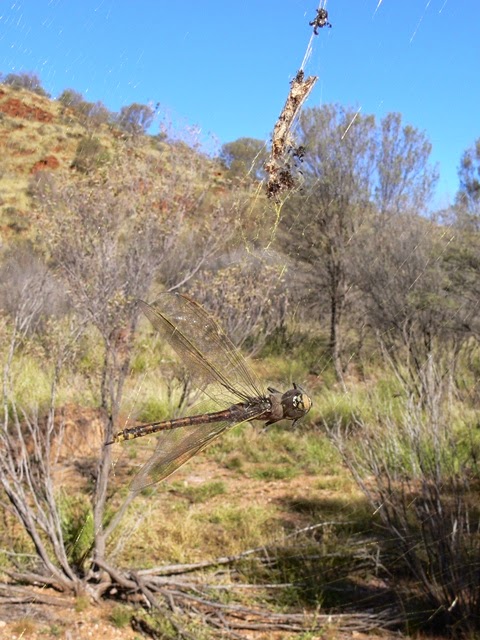
A large Australian Emperor dragonfly caught in the web of an
Australian Golden Orb-weaving Spider, Nephila edulis

Apart from catching out unwary humans, the webs of these spiders are strong enough to ensnare very large insects and even small birds and bats. The photo above, taken at Simpsons Gap west of Alice Springs in May 2010, was the first I'd taken of an Australian Emperor dragonfly and I was a little put out (and humbled) that a spider had got to it first. 


Nephila, the genus that comprises the golden orb-weaving spiders, occurs in three main, essentially tropical regions around the world. There are two species in the Americas, from the southern US to Brazil and Argentina, including Nephila clavipes, one of the best-studied spiders in the world; 6-8 species from Africa, ranging from the southern tip of the Arabian Peninsula to Madagascar; and there are about 16 species in the Indo-Australasian region, from India and China through to as far east as Tonga and Samoa. Australia (including its dependencies Cocos (Keeling) Islands, Christmas Island, Norfolk and Lord Howe Islands) is home to four species, though only three of these occur on mainland Australia. 

Incidentally, the genus name Nephila, is derived from the Greek words nen = to spin, and philos = love - hence 'love to spin' or 'fond of spinning', or as further derived (or corrupted) for the purposes of the title for this post - 'spin-lovers'. 

The spinnerets are clearly visible towards the ventral tip of the abdomen on this
Australian Golden Orb-weaving Spider (Bowra, Queensland, April 2014).

The three species of Nephila occurring in Australia are:
  • Nephila pilipes - Giant Golden Orb-weaving Spider, 
  • Nephila plumipes - Humped Golden Orb-weaving Spider
  • Nephila edulis - Australian Golden Orb-weaving Spider

The Giant Golden Orb-weaving Spider occurs up the east coast of Australia, north from about Bellingen, and across the Top End. It also occurs widely throughout the New Guinea region and as far east as Vanuatu, on Christmas Island, and through much of South-East Asia and as far north as China. It is generally found in rainforest or other densely vegetated situations. 

Compared to the other Australian species, the abdomen of N. pilipes is quite elongated, the sternum is usually entirely black, the palps are bright yellow or reddish, and the yellow patches on the legs are restricted to what look like enamel spots on the underside of the main joints. 


The Giant Golden Orb-weaving Spider Nephila pilipes -
this one at Fogg Dam, east of Darwin in the Northern Territory, June 2008.

Another Giant Golden Orb-weaving Spider, this one with at least three tiny yellowish males 
in the web around her. Litchfield National Park, south of Darwin, June 2008. 

In this genus, the males are much smaller that the females, up to an order of magnitude so (in linear dimensions), and they may be as little as 1%-5% of the weight of a fecund adult female. So it's not surprising that spiders of this genus have been the subject of much study, particularly the evolution of sexual size dimorphism and of their reproductive biology and behaviour more generally. 

The comparatively tiny males tend to live in the female's web as well - up to about six males per web - a dangerous way to live as they are apt to be subjected to sexual or copulatory cannibalism, a not uncommon trait amongst various groups of spiders. Apparently there is also a fair degree of size variability between males, and they compete for the sexual favours of the female, who is not at all averse to accepting the (careful) advances of multiple males. For the males, there is a play off between being larger (and thereby being more successful in seeing off the smaller males from the centre of the web where mating takes place) and being smaller (and thus less likely to be cannibalised, either before, during or after the event, by the female).


The Humped Golden Orb-weaving Spider Nephila plumipes occurs predominantly along the eastern coast of Australia, from Cape York to the southern coast of NSW, but also across the Top End and through many of the Pacific Islands. Particularly in the southern part of the range it is strongly associated with mangrove habitats, but it is also found in other coastal situations and may even be found, usually sporadically or at low density, up to several hundred kilometres inland. They are common on islands, including those of the Great Barrier Reef.

Humped Golden Orb-weaving Spider Nephila plumipes, Currarong NSW, January 2008.

Humped Golden Orb-weaving Spider Nephila plumipes,
Lady Musgrave Island, Great Barrier Reef, Queensland, January 2014.

The Australian Golden Orb-weaving Spider Nephila edulis is the most widespread and probably most common of the three Australian species. It occurs throughout Australia, including in arid regions, tropical savannas, subtropical and temperate coastal areas, and subalpine habitats. It is the only Nephila species in Tasmania, and also occurs to a lesser degree in New Zealand, New Caledonia, New Guinea and perhaps in Java. 

Although often very common, it also tends to be more transient, particularly in more arid regions, where populations may be very dense one year and then virtually disappear for several years. 

Australian Golden Orb-weaving Spider Nephila edulis, Uriarra Crossing, ACT, March 2005.

Australian Golden Orb-weaving Spider Nephila edulis, Weddin Mountain, NSW, March 2005.

Australian Golden Orb-weaving Spider Nephila edulis, Weddin Mountain, NSW, March 2015. 
The tiny male is very close to the female, and presumably approaching in order to mate. 
This photo was taken 10 years after the previous one but at the same location - I wonder if it could be a descendant? 

Australian Golden Orb-weaving Spider Nephila edulis, Bowra, Queensland, April 2014.

Australian Golden Orb-weaving Spider Nephila edulis, Simpsons Gap, NT, May 2010.

Nephila webs characteristically have a line of silk-wrapped food items strung out above the hub, or centre of the web. This is known as a food cache, and is used during food shortages. There may be as many as 15 items in the cache, depending on need and availability of prey. 

But not all prey is necessarily eaten. While prey items that are eaten tend to be fairly large and frequently include grasshoppers, flies, beetles, butterflies, and even dragonflies; some insects such as vespid wasps and a range of unpalatable insects may be avoided or actually removed from the web. 

Smaller insects may also be eaten, but it seems there are usually enough to support another type of small spider that also often inhabits the webs as a kleptoparasite. It is a spider from the family Theridiidae (a very diverse family which includes the redback) called Argyrodes and there are species that occur in the webs of virtually all Nephila species worldwide, including these three Australian species. I'll have to keep my eye out as so far I haven't noticed them. 

There was a review of the Nephila genus in Australasia done in the mid-2000s by Mark Harvey, Andrew Austin and Mark Adams. The comprehensive paper, The systematics and biology of the spider genus Nephila (Araneae:Nephilidae) in the Australasian region, published in Invertebrate Systematics, is available as a pdf from http://www.publish.csiro.au/paper/IS05016.htm. It's well worth a look.