Showing posts with label Spiders. Show all posts

Tuesday, 21 April 2015

Spin-lovers - Nephila in Australia


WARNING! Graphic images of spiders follow - arachnophobes should not proceed.


Spin-lovers - Nephila in Australia


I have no trouble visualising my earliest clear recollection of an encounter with a golden orb-weaving spider! It would have been in 1974 or '75, I was probably 15 years old, and it was just down from the Baha'i Temple in Ingleside, northern Sydney. I and a couple of school friends were crashing through the bush on our first ever bout of orienteering, a sport quite new to Australia at the time and just introduced to the Pittwater High School sports options. Pushing our way through the dense and prickly bush, I suddenly recoiled abruptly on impact with a strong and stickily elastic web - my feet continued their forward progress, perhaps slipping on the sandy soil, but the rest of me went backwards and down, and I landed hard.

I must have already been familiar with these spiders and their webs, as I knew exactly what had happened. And had I not been running at full tilt, I'd probably have seen and avoided the web, as they are large, prominent and glow golden-yellow in the sunshine - hence the common name for this group of spiders.
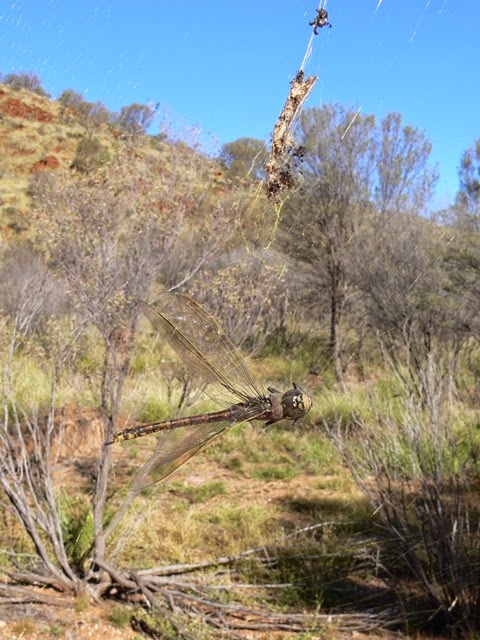

A large Australian Emperor dragonfly caught in the web of an
Australian Golden Orb-weaving Spider, Nephila edulis. 

Apart from catching out unwary humans, the webs of these spiders are strong enough to ensnare very large insects and even small birds and bats. The photo above, taken at Simpsons Gap west of Alice Springs in May 2010, was the first I'd taken of an Australian Emperor dragonfly and I was a little put out (and humbled) that a spider had got to it first. 


Nephila, the genus that comprises the golden orb-weaving spiders, occurs in three main, essentially tropical regions around the world. There are two species in the Americas, from the southern US to Brazil and Argentina, including Nephila clavipes, one of the best-studied spiders in the world; 6-8 species from Africa, ranging from the southern tip of the Arabian Peninsula to Madagascar; and there are about 16 species in the Indo-Australasian region, from India and China through to as far east as Tonga and Samoa. Australia (including its dependencies Cocos (Keeling) Islands, Christmas Island, Norfolk and Lord Howe Islands) is home to four species, though only three of these occur on mainland Australia. 

Incidentally, the genus name Nephila, is derived from the Greek words nen = to spin, and philos = love - hence 'love to spin' or 'fond of spinning', or as further derived (or corrupted) for the purposes of the title for this post - 'spin-lovers'. 

The spinnerets are clearly visible towards the ventral tip of the abdomen on this
Australian Golden Orb-weaving Spider (Bowra, Queensland, April 2014).

The three species of Nephila occurring in Australia are:
  • Nephila pilipes - Giant Golden Orb-weaving Spider, 
  • Nephila plumipes - Humped Golden Orb-weaving Spider
  • Nephila edulis - Australian Golden Orb-weaving Spider

The Giant Golden Orb-weaving Spider occurs up the east coast of Australia, north from about Bellingen, and across the Top End. It also occurs widely throughout the New Guinea region and as far east as Vanuatu, on Christmas Island, and through much of South-East Asia and as far north as China. It is generally found in rainforest or other densely vegetated situations. 

Compared to the other Australian species, the abdomen of N. pilipes is quite elongated, the sternum is usually entirely black, the palps are bright yellow or reddish, and the yellow patches on the legs are restricted to what look like enamel spots on the underside of the main joints. 


The Giant Golden Orb-weaving Spider Nephila pilipes -
this one at Fogg Dam, east of Darwin in the Northern Territory, June 2008.

Another Giant Golden Orb-weaving Spider, this one with at least three tiny yellowish males 
in the web around her. Litchfield National Park, south of Darwin, June 2008. 

In this genus, the males are much smaller that the females, up to an order of magnitude so (in linear dimensions), and they may be as little as 1%-5% of the weight of a fecund adult female. So it's not surprising that spiders of this genus have been the subject of much study, particularly the evolution of sexual size dimorphism and of their reproductive biology and behaviour more generally. 

The comparatively tiny males tend to live in the female's web as well - up to about six males per web - a dangerous way to live as they are apt to be subjected to sexual or copulatory cannibalism, a not uncommon trait amongst various groups of spiders. Apparently there is also a fair degree of size variability between males, and they compete for the sexual favours of the female, who is not at all averse to accepting the (careful) advances of multiple males. For the males, there is a play off between being larger (and thereby being more successful in seeing off the smaller males from the centre of the web where mating takes place) and being smaller (and thus less likely to be cannibalised, either before, during or after the event, by the female).


The Humped Golden Orb-weaving Spider Nephila plumipes occurs predominantly along the eastern coast of Australia, from Cape York to the southern coast of NSW, but also across the Top End and through many of the Pacific Islands. Particularly in the southern part of the range it is strongly associated with mangrove habitats, but it is also found in other coastal situations and may even be found, usually sporadically or at low density, up to several hundred kilometres inland. They are common on islands, including those of the Great Barrier Reef.

Humped Golden Orb-weaving Spider Nephila plumipes, Currarong NSW, January 2008.

Humped Golden Orb-weaving Spider Nephila plumipes,
Lady Musgrave Island, Great Barrier Reef, Queensland, January 2014.

The Australian Golden Orb-weaving Spider Nephila edulis is the most widespread and probably most common of the three Australian species. It occurs throughout Australia, including in arid regions, tropical savannas, subtropical and temperate coastal areas, and subalpine habitats. It is the only Nephila species in Tasmania, and also occurs to a lesser degree in New Zealand, New Caledonia, New Guinea and perhaps in Java. 

Although often very common, it also tends to be more transient, particularly in more arid regions, where populations may be very dense one year and then virtually disappear for several years. 

Australian Golden Orb-weaving Spider Nephila edulis, Uriarra Crossing, ACT, March 2005.

Australian Golden Orb-weaving Spider Nephila edulis, Weddin Mountain, NSW, March 2005.

Australian Golden Orb-weaving Spider Nephila edulis, Weddin Mountain, NSW, March 2015. 
The tiny male is very close to the female, and presumably approaching in order to mate. 
This photo was taken 10 years after the previous one but at the same location - I wonder if it could be a descendant? 

Australian Golden Orb-weaving Spider Nephila edulis, Bowra, Queensland, April 2014.

Australian Golden Orb-weaving Spider Nephila edulis, Simpsons Gap, NT, May 2010.

Nephila webs characteristically have a line of silk-wrapped food items strung out above the hub, or centre of the web. This is known as a food cache, and is used during food shortages. There may be as many as 15 items in the cache, depending on need and availability of prey. 

But not all prey is necessarily eaten. While prey items that are eaten tend to be fairly large and frequently include grasshoppers, flies, beetles, butterflies, and even dragonflies; some insects such as vespid wasps and a range of unpalatable insects may be avoided or actually removed from the web. 

Smaller insects may also be eaten, but it seems there are usually enough to support another type of small spider that also often inhabits the webs as a kleptoparasite. It is a spider from the family Theridiidae (a very diverse family which includes the redback) called Argyrodes and there are species that occur in the webs of virtually all Nephila species worldwide, including these three Australian species. I'll have to keep my eye out as so far I haven't noticed them. 

There was a review of the Nephila genus in Australasia done in the mid-2000s by Mark Harvey, Andrew Austin and Mark Adams. The comprehensive paper, The systematics and biology of the spider genus Nephila (Araneae:Nephilidae) in the Australasian region, published in Invertebrate Systematics, is available as a pdf from http://www.publish.csiro.au/paper/IS05016.htm. It's well worth a look. 

Sunday, 12 October 2014

Buddigower Banding - an unsprung Spring?


The weather was unseasonably warm and the bush very dry. The last time I had been out there banding, exactly four years prior, the place had been awash with wildflowers and everything seemed fresh and vibrant. This time it all seemed a little tired.

Buddigower Nature Reserve is in central New South Wales, just 7 km further along a dirt road from the Charcoal Tank Nature Reserve (12 km south of West Wyalong) where we have a regular bird banding site. We generally only get to Buddigower about every three years, and this time the gap had been four. Apart from the core group of eight banders, there were also five COG members (COG = Canberra Ornithologists Group) along for the ride on this Labour Day long weekend (3-6 October).

I’d been in Melbourne for work on the Friday so couldn’t get out to Buddigower until later on the Saturday afternoon. But this did mean we were travelling in daylight and along the way we stopped for a couple of reptiles on the road to ensure they didn't become road-kill.


A Shingleback Lizard Tiliqua rugosa (Scincidae)
was persuaded to remove itself from the middle of the road.


And a beautiful Sand Monitor (or Gould's Goanna) Varanus gouldii (Varanidae) welcomed us to Buddigower


while always keeping a close eye on us. 

When we arrived at Buddigower, Karen and I set to to get a few nets up before dusk, in the same area we had banded those four years previously, then went about the business of setting up camp. It seems Mark and his crew, who had set up on the Friday afternoon, hadn’t done so well, with less than 20 birds banded for the day.

The dryness may well be the first sign of the predicted el Niño cycle. Whatever the case, there wasn’t much flowering; certainly not the main woodland eucalypt species, nor the widespread understorey of cassinia bushes. But there were several acacias still in flower. And a few isolated cassia bushes, as well as a scattering of Calytrix, Thysanotus, and some everlastings, added splashes of colour (mainly yellow) to the otherwise fairly muted landscape.

Currawang Acacia doratoxylon (Fabaceae-Mimosaceae)

Streaked Wattle Acacia lineata (Fabaceae-Mimosaceae)

A cassia (probably Cassia nemophila) (Fabaceae-Caesalpiniaceae). In the early morning the surrounding bushland was redolent with the scent from these bushes, smelling like freshly prepared garam masala!

Common Fringe-myrtle Calytrix tetragona (Myrtaceae)

Twining Fringe-lily Thysanotus patersonii (Anthericaceae)


A 'Yellow Buttons' everlasting (Chrysocephalum sp. either apiculatum or semipapposum)


There were certainly birds about. They were quite vocal, and fairly active, but mostly they kept to the canopy so we had little success at the nets. At our site, Karen and I managed just 23 birds for the weekend: 7 White-browed Babblers, several Eastern Yellow Robins (including a presumed family party of mum, dad, and a stripe-headed juvenile in the first net on the first round), 3 White-eared Honeyeaters, a couple of Red-capped Robins, a Variegated Fairy-wren, a very obstreperous kookaburra (with its mate egging it on from the sidelines), a trio of Grey Fantails and a Willie Wagtail. The juvenile robin, as well as a few birds with brood patches, were the only signs that some birds at least were breeding. The Rufous Whistlers, Weebills, Inland Thornbills, Western Gerygones, Jacky Winters, Grey Shrike Thrush and Mistletoebirds were constant and welcome vocal companions but all stayed resolutely away from the nets.

White-browed Babbler Pomatostomus superciliosus (Pomatostomidae)
one of the seven caught was a re-trap from the 2010 trip.

Male Red-capped Robin Petroica goodenovii (Petroicidae)

This little Inland Thornbill Acanthiza apicalis (Acanthizidae) came to investigate why the Red-capped Robin was making such a fuss while he was being photographed immediately prior to release.

The middle of the day was hot. 36 degrees hot! More than the predicted 32, which would have been bad enough, and well above the long-term average for October (about 24ºC). The birds quietened down, but the mad-dog non-Englishman (me, in this case) continued his vain pursuit of them - in vain.

The insects, however, seemed to be enjoying the conditions. Several butterflies (Meadow Argus, Australian Painted Lady, Caper White, and a tiny grass blue) were around in small numbers. One Meadow Argus had taken a liking to, indeed laid claim to, a three square metre patch of track and was flushed each and every time I passed to check the net. Grasshoppers of several species gave me some great opportunities to play with my new macro lens, as did several robber flies, and the occasional dragonfly hummed by (possibly an emerald or emperor?) or perched on exposed twigs (Wandering Percher).

Australian Plague Locust Chortoicetes terminifera - brown form.

Australian Plague Locust Chortoicetes terminifera - green form.

Grasshopper 'type B' - red & grey form.

Grasshopper 'type B' - orange form.

The 'type B' grasshoppers would wave their front legs about
in what looked like some kind of semaphoric signalling 

and had gnarly 'old man' faces.

Robber fly 'type A' - male

Robber fly 'type A' - female.
The dense cluster of bristles in front of the face is called a mystax;
it helps to protect the fly against the struggles of any incalcitrant insect prey.

At first I thought this was a weird-looking robber fly (Asilidae) but on looking it up determined that it is in fact a species of Apiocera, from the family Apioceridae - closely related to Asilidae but one I've never come across before. Woo-hoo!


With evening, the temperature dropped slightly and the spiders came out to prowl, their eye-shine, reflecting back from the ground in front of our head-lamps, as bright as the stars above. More scope for a bit of macro experimentation. While I focussed on the larger spiders for photography, it was evident there were very many young spiders about, clearly following a major recent hatching event.

A wolf spider on the prowl.

Ain't she beautiful!

Another wolf spider hiding in its burrow - this one has very dark chelicerae compared to the first one.

I managed to induce it out of its burrow by scratching the ground with a small twig...

and got a great face on photo before it scuttled back down its hole. 


Another night-time discovery provided, for me, the highlight of the trip. There had been a Spotted Nightjar calling sporadically the previous two evenings, but on Sunday night a brief bout of spotlighting by some of the group located a nightjar nesting on the ground not far from camp (thanks Kathy), while its mate continued to call in its distinctive and eerie way as it swept over the tree-tops or the more distant paddocks. I’d just settled down for a well needed sleep when alerted to the find, but I threw off the sheet and was pulling on jeans in an instant for this opportunity.

Spotted Nightjar Eurostopodus argus (Caprimulgidae) on its nest at night.

Spotted Nightjars lay a single, pale green, speckled egg,
the 'nest' being a simple scrape in the leaf litter.

Next morning, the Spotted Nightjar's camouflage in the dappled sunlight was exquisite. Just as well I knew exactly where the nest was.

Spotted Nightjar Eurostopodus argus (Caprimulgidae) on its nest - what a great bird


So while the bird banding could have been better, and spring breeding isn't perhaps in fullest swing, the trip was undeniably a success. 


Tuesday, 7 October 2014

Macro Magic - First day's play


I've just recently acquired a new macro lens (Canon EF 100 mm 1:2.8 L). 

So on the first day, I went out for a play. Didn't need to go far, no need for the car,
just out to the garden, to see what was there.

The following is just a self-indulgent gallery of some of those first pictures. The flowers were easy targets to begin with.


Tritelia


Grape Hyacinth 


Gazania


Dutch Iris


Eucalypt blossom and buds

But with the flowers come the pollinators. The first hoverflies (family Syrphidae) are the harbingers of spring for me, and are the first sure sign that the warmer weather has finally arrived after the long cold Canberra winter. But other flies, mainly calliphorids I think, were also getting amongst it, and it was amazing to see just how much pollen they were picking up and spreading around. 


To a prospecting hoverfly, the protruding stamens of a cluster of viburnum flowers must look like a forest of food.


Hoverfly at Chinese broccoli flower


and again


closer...


... and closer.


Flies are often said to be continuously 'washing their hands' - I think perhaps they're actually rubbing them with glee.


A stunning golden-bummed calliphorid fly


and again.


This fly is carrying a massive load of pollen, but not from the viburnum it's currently on.


Whereas this fly does appear to be spreading viburnum pollen.


Bees are of course better known generally as pollinators, and they too were very active on this day, particularly in the viburnum, the grevilleas, and the rosemary. Until looking at these photos I hadn't realised that even the humble rosemary flower is exquisitely structured to ensure the bee comes into contact with the over-arching stigma. 


Honey bee at grevillea flower


The style of the rosemary flower arches over so the stigma contacts the bee's head or thorax to increase the chances of pollination.


I hadn't even realised this tiny beetle (about 2-3 mm long) was there until later looking at the photos.

And everywhere I looked there was something different to focus my new toy on.


Scale on a eucalypt leaf suddenly looked like miniature rock oysters


common sugar ants took on individual personalities

a case moth caterpillar hung discretely in the callistemon

and a tiny early instar katydid very nearly avoided detection.

And with such an abundance of insect life, the tiny jumping spiders (family Salticidae) presumably make a killing...


Jumping spider (type A)


Jumping spider (type B)

I'm going to have a lot of fun with this new lens!