
In the second half of May, Karen and I took off for Darwin. The minimum overnight temperatures in Canberra in the days preceding our departure had bottomed out at -6 C and we were very much looking forward to the tropical heat of Darwin: low to mid 30s during the day and overnight dropping to as cold as 20 C!
The underlying reason for the Trip was Karen’s niece’s wedding (thanks Emily!), but we were going to take advantage of the opportunity and finally get to Kakadu National Park. And Katherine Gorge in Nitmiluk National Park.
 |
| Wedding on a Darwin sand bar. |
 |
| Part of the Nourlangie (Burrunggui) Rock outcrop, Kakadu National Park. |
 |
| Sunset cruise on Katherine Gorge, Nitmiluk National Park. |
There are lots of stories that could be told, but this post will focus only on the dragonflies I saw on the trip. One of the things about the tropics is that dragonflies are around even in the months of the southern winter. The last dragonflies I saw in Canberra for the season were a few Tau Emeralds, back on 18 April, along Sullivan’s Creek where it ‘flows’ through the Australian National University on its way to Lake Burley Griffin. And that was about a month after most species had disappeared from the local rivers, wetlands and ponds around mid-March.
The northern parts of Australia are very much dominated, in terms of dragonfly fauna, by the very large and cosmopolitan family Libellulidae. And damselflies, the common and obvious ones at least, are predominantly represented by the Coenagrionidae. On this trip I encountered a total of 19 species of dragonflies and damselflies. Of these, four were Coenagrionid damselflies (two of which were new for me), there was the Australian Tiger from the family Gomphidae (or Lindeniidae by some taxonomies), and 14 were Libellulids of various kinds (including six new). So eight new species for the trip which I didn't think was too bad.
Just to put this into context a bit – although I’ve taken photos of dragonflies that caught my attention in the past, including the stunning Cape York ones described in an earlier post (see Cape Dragonflies), it’s only been in the past 12 months or so that I’ve really looked for dragonflies in a more systematic and concerted way.
Just to put this into context a bit – although I’ve taken photos of dragonflies that caught my attention in the past, including the stunning Cape York ones described in an earlier post (see Cape Dragonflies), it’s only been in the past 12 months or so that I’ve really looked for dragonflies in a more systematic and concerted way.
 |
| The Slender Skimmer Orthetrum sabina was one of the more common of my new species. |
The species I’d already seen, either on a previous trip to Darwin in 2008 for Karen’s other niece’s wedding (Thanks Mel!), in tropical Queensland, or just elsewhere in Australia, were:
Eastern Billabongfly
Common Bluetail
Australian Tiger
Blue Skimmer
Palemouth
Scarlet Percher
Wandering Percher
Painted Grasshawk
Red Arrow
Graphic Flutterer
Common Glider
And the eight new species from this trip are:
Blue Riverdamsel
Colourful Bluetail
Red Baron
Speckled Skimmer
Rosy Skimmer
Slender Skimmer
Chalky Percher
Pygmy Percher
On this trip, the first opportunity I had to look for dragonflies was at the Sanctuary Lakes in Gunn, a suburb of Palmerston 20 km south-east of Darwin. These lakes were just down the road from where we were staying with Karen’s sister, Jen, and her husband Steve, so I ended up going there three times over our first weekend. The first visit, on the Friday afternoon not long after we had arrived (no point wasting time!) I was essentially bird watching, and sadly without camera, but did notice several Common Bluetails and Eastern Billabongflies, both species familiar to me and common in Canberra. But over the next two visits (with camera) I also picked up Blue Riverdamsels and Colourful Bluetails (both new as indicated above), a Blue Skimmer and Wandering Percher (again common in Canberra) as well as a Red Arrow which I’d only seen once previously (in Gladstone, Queensland), and several Slender Skimmers and a Pygmy Percher (both new).
So almost half of all the dragonfly species I saw on this trip, I first saw at these local suburban lagoons.
 |
| A pair of Common Bluetails Ischnura heterosticta in the 'wheel' position, i.e. mating. |
 |
| A pair of Eastern Billabongflies Austroagrion watsoni mating. |
 |
| A Blue Riverdamsel Pseudagrion microcephalum, the first of my new species. |
 |
| A male Colourful Bluetail Ischnura pruinescens - new species number 2! |
 |
| Blue Skimmer Orthetrum caledonicum on a water lily bud. |
 |
| Wandering Percher Diplacodes bipunctata, also on a water lily bud; obviously very convenient perches. |
 |
| A male Red Arrow Rhodothemis lieftincki, brilliant in the bright sunlight. |
 |
| Despite being very common in the right places, this was my first Slender Skimmer Orthetrum sabina. |
 |
| Another Slender Skimmer Orthetrum sabina. |
 |
| And my first Pygmy Percher Nannodiplax rubra, |
Before leaving Darwin and heading across to Kakadu, we made a quick visit to Buffalo Creek, at the northern limit of peri-urban Darwin. The purpose of this visit was to try (yet again) to see a fairly large but very elusive bird, a Chestnut Rail Eulabeornis castaneoventris, for which Buffalo Creek has long been a supposedly likely spot. But the tides and the activity of boat and fishing people were against us and I dipped for the fifth time. But I did see the first of several Painted Grasshawks in some roadside vegetation on the way back. Lighting and the angle of the sun can make a difference, but I have the impression that the Top End versions of this species I’ve seen have in general been less intensely coloured than those I've seen in Cape York. I don’t know how valid this assessment might be, or whether it's just artefactual of my limited experience with the species.
 |
| Painted Grasshawk Neurothemis stigmatizans. |
Our first stop on the drive across to Kakadu was at Fogg Dam, a beautiful wetland spot, well-known to birdwatchers. And it impressed as much as it had on our first visit there in June 2008. On that earlier trip I had photographed a dragonfly that turned out to be a Red Swampdragon. It remains the only individual of this species I’ve seen.
 |
Red Swampdragon Agrionoptera insignis, at Fogg Dam, about 60 km east of Darwin (June 2008).
|
Along the causeway that divides the lagoon in half, I saw a few more Slender Skimmers (now old mates!), a few Graphic Flutterers, and my first Chalky Percher. There were also hundreds of Common Bluetails, mostly paired up in an apparent mating frenzy .
 |
| A female Chalky Percher Diplacodes trivialis on the causeway at Fogg Dam. New species number 5. |
 |
| One of many such branches festooned with mating Common Bluetails Ischnura heterosticta. |
Another interesting difference was that the male Common Bluetails I saw in the Top End all tended to have the humeral stripe very much reduced relative to those I’m used to in Canberra. Also, some of the females of the mating pairs were as blue as the males. I’ve not seen this in Canberra, where all the females I’ve seen so far have been of the more typical dull brownish colour with at best an orange or greenish tinge to the thorax. Apparently this colour form variation in females is not especially uncommon in some Coenagrionids, including Ischnura. It's been hypothesized that, although this might appear to be disadvantageous if it reduced the likelihood of mating, it might also be advantageous if the male-coloured females were subject to less harassment during egg laying in high population density situations (page 52 of Dragonflies of the World by Jill Silsby, 2001).
 |
| The female of this mating pair of Common Bluetails Ischnura heterosticta is of the male or blue colour form. |
 |
| Reduced humeral stripe of Common Bluetail - mating male in Darwin |
 |
| Normal humeral stripe of Common Bluetail - mating male in Canberra |
We left Fogg Dam and headed east towards Kakadu, stopping briefly at the Mary River Billabong. It was hot, and getting close to lunch time, so we didn’t stay long, but I did pick up some more Eastern Billabongflies, Colourful Bluetails, a Wandering Percher and my first Australian Tiger for the trip.
 |
| Australian Tiger Ictinogomphus australis. |
Single individuals of Australian Tiger, Red Arrow and Pygmy Percher were also present at Flying Fox Creek (within Kakadu, now at a small creek crossing where we stopped to have a quick picnic lunch).
Our first real stop in Kakadu was at Mamukala Wetlands. Here I saw several Graphic Flutterers, a Wandering Percher, and the first Common Glider for the trip.
 |
| Another Australian Tiger at Flying Fox Creek... |
 |
| ... and getting accustomed to seeing Pygmy Perchers. |
Our first real stop in Kakadu was at Mamukala Wetlands. Here I saw several Graphic Flutterers, a Wandering Percher, and the first Common Glider for the trip.
 |
| Graphic Flutterer Rhyothemis graphiptera. |
 |
| Graphic Flutterer Rhyothemis graphiptera. |
We finally made it to Jabiru, where we’d be staying overnight, and just before sundown we had a quick look around the lake there. The only dragonflies I saw were Graphic Flutterers and a couple of Scarlet Perchers, but they were interesting for their evening behaviour. The Graphic Flutterers were swarming in clouds of up to 20 or so, and both they and the perchers were alighting on the highest tips of various palm or pandanus fronds. I speculated on whether the flutterers were swarming as a pre-roost behaviour, or whether they might have been following swarms of small midges or other potential food insects, but I really don't know.
 |
| Late afternoon Graphic Flutterer |
 |
| Part of an evening swarm of Graphic Flutterers |
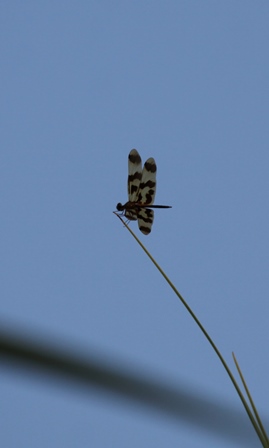 |
| A pre-roosting Graphic Flutterer |
 |
| And a parked percher amidst the pandanus. |
The next day, after an exhilarating short flight over the western Arnhemland escarpment and East Aligator River, we headed down to Nourlangie. At the nearby Anbangbang Billabong we again encountered a few Graphic Flutterers and a Pygmy Percher. Higher up, a lone Common Glider posed beautifully on the top of a twig on a bush on the rocky escarpment of the Nawurlandja lookout. At Nourlangie itself near the rock art galleries, well away from any obvious water, were a male and female Painted Grasshawk.
 |
| Common Glider Tramea loewii at the Nawurlandja lookout. |
 |
| Another take on the Common Glider Tramea loewii at the Nawurlandja lookout. |
 |
| Female Painted Grasshawk Neurothemis stigmatizans at Nourlangi. |
From there we moved on to the Gagudju Lodge at Cooinda, near the adjacent famous Yellow Water billabong and floodplains. We did the obligatory early morning cruise at Yellow Water, where my focus was on the birdlife. I was desperate to see a Great-billed Heron which are sometimes seen here (I’d not yet managed to see them around Darwin). The only dragonflies I noticed were a few Blue Riverdamsels, including one that had decided the pronounced eyebrow ridge of an Estuarine Crocodile was a far superior perching spot to any of the nearby emergent branches! (This was also the first Estuarine Crocodile, or 'salty', I'd ever seen).
 |
| A Blue Riverdamsel gets familiar with a Estuarine or Saltwater Crocodile. |
After a fantastic buffet breakfast back at the Lodge, Karen and I decided to have a fairly relaxed day, so I spent a bit of time later in the morning just wandering about the grounds. There is a small jetty type affair on the Jim Jim creek just near our accommodation which provided access to some woodland and its birds as well as the creek. Here, in between ticking off birds, I photographed another Australian Tiger, but also a couple of other dragonflies that, after returning to the air-conditioned comfort of our room, I determined from the field guide to be Speckled Skimmers.
But I couldn’t understand why the only photo in the field guide was of a dried museum specimen. It wasn’t until I got home to Canberra and started looking into things that I discovered how unlikely it might have been to have seen this species. It seems (based on the Atlas of Living Australia) that there are only half a dozen or so (museum) records of this species from Australia and that they were not known to occur in Australia until 1968 when John Watson collected a specimen from eastern Arnhemland. (The species was first described by Lieftinck in 1933 based on a New Guinea specimen). And, as far as I can determine, there are no previous photographs of a living individual anywhere. So I’m really chuffed to have seen these dragonflies and to have got the photos.
 |
| Speckled Skimmer Orthetrum balteatum - possibly the first ever published photo of a live individual in the wild? |
 |
| Speckled Slimmer Orthetrum balteatum - Cooinda, Kakadu National Park. |
To this point, all the dragonflies and damselflies I’d come across were associated with lagoons or riverine pools. At Gunlom, in the south west of Kakadu, we were up in the escarpment country with smaller faster-flowing creeks, but even here all the dragonflies I saw were still associated with slower-moving sections of water. I finally came across my first Rosy Skimmer, a female Red Arrow (which looks quite different to the bright red male), and another bright red species which I’m pretty sure is a Red Baron (also new).
 |
| A Rosy Skimmer Orthetrum migratum - one I'd been wanting to see and now my 7th new species for the trip. |
 |
| A female Red Arrow Rhodothemis lieftincki (compare to male in photo above). |
 |
| I think I'm fairly sure this might be a Red Baron, Urothemis aliena. Whatever, it was my 8th and final new species for this trip. |
From here on I didn't see so many dragonflies. At Pine Creek I was focused on seeing Hooded Parrots, and at Katherine Gorge it was sunset anyway - stunning for the scenery but not so good for odonates. At Edith Falls we did see more Scarlet and Pygmy Perchers and Eastern Billabongflies. And in Darwin, we were of course finally concentrating on the wedding which was on the final day of our northern sojourn.
But I did see a Palemouth at the picnic area at the outlet creek from Manton Dam on our way back to Darwin (I'd only seen a couple of these previously, in Gladstone in Jan 2014), and I was surprised to see a Chalky Percher right out on the intertidal rocks at Nightcliff in Darwin - so I'll just finish up with a couple of photos of them as this post has gone on for longer than I expected anyway.
 |
| A male Palemouth Brachydiplax denticauda. |
 |
| Chalky Percher (immature male?) on tidal rocks at Nightcliff, Darwin. |
It was an excellent trip. Not just for the dragonflies either - my next post will be on the new birds I saw...
But seriously, it was a fantastic trip - we finally got to Kakadu and Katherine Gorge, the weather was perfect, and there was lots of catching up with family, including weddings and new generations, which doesn't happen frequently enough. Good reason to return...


