Wednesday, 28 January 2015

Lake Wollumboola Sand Plovers


Following my previous post about my White-rumped Sandpiper twitch to Lake Wollumboola on 13 January, I received an email from Chris Brandis about the sand plovers that have been being reported from Lake Wollumboola. In my original post I included in the list of birds seen a single Lesser Sand Plover (Charadrius mongolus). This identification was no doubt influenced partly by the fact that that is what other people had been reporting from the site, but probably also partly because Lesser Sand Plovers are generally more common on the NSW coast than Greater Sand Plovers (Charadrius lechenaultii), though neither is seen there either particularly regularly or in great numbers. In so doing I committed one of the birdwatcher's cardinal sins!

Lesser and Greater Sand Plovers are notoriously difficult to tell apart at times, especially when the two are not present together for comparison. The National Photographic Index of The Shorebirds of Australia has this to say: 
In a mixed flock of waders, the Large Sand Plover (sic - an alternative name for the Greater Sand Plover) may be distinguished from other small plovers by its slightly larger size, longer legs and bigger, heavier bill. But when seen alone in its eclipse plumage, as is generally the case in Australia, it resembles the Mongolian plover (sic - an alternative name for the Lesser Sand Plover) and the Double-banded Plover. Considerable experience and expertise is required to distinguish with confidence between the Mongolian and the Large Sand Plover, and there are few features which are infallibly diagnostic.  Much reliance must be placed on subjective impressions, and these have been perhaps most succinctly summarised by M. J. Rogers, who said that, to him, the Mongolian Plover is quite a pleasing little bird, while the Large Sand Plover is "an ugly brute, with a body too small for its legs, a head too large for its body and a bill too large for its head"!

So Chris's comments, that he thought he had seen four Greater Sand Plovers, not Lessers, made me go back and look at my photos, none of which I had really paid a great deal of attention to, either in the taking or the subsequent assessment.

But looking at them now, it seems likely that the two birds for which I have reasonable photos are both Greater Sand Plovers. A third bird was seen but only shows up as a blurred bird in the distance in my photos, but even it I assume was also a Greater Sand Plover.
[But it seems I was quite wrong in this conclusion - see Postscript at end of this post...]

The first two photos in the following sequence are of the same bird, and the other seven photos are of another bird (and the final two photos are from Northwest Island in the Great Barrier Reef for comparison). 

The stance, long-legged appearance, and long bill of the first bird seems to me to be fairly characteristic for a Greater Sand Plover. 


Wollumboola bird #1

Wollumboola bird #1


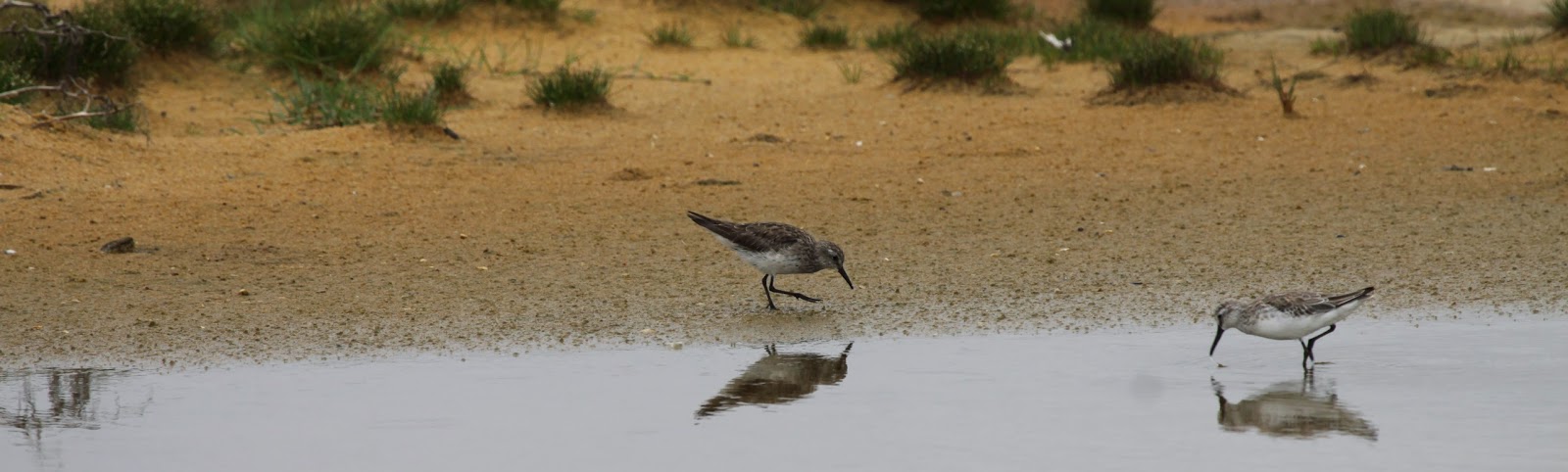
The perspective of the second bird as it walks away from me makes the distinguishing features less obvious, but its size compared to the Red-necked Stint in the  photos is also supportive of a Greater Sand Plover ID.

Wollumboola bird #2

Wollumboola bird #2

Wollumboola bird #2


The size and shape of the bill in the second bird is more equivocal.

Wollumboola bird #2

Wollumboola bird #2


But the largely whitish rump and tail edges of the bird in blurred flight is more suggestive of a Greater Sand Plover - a Lesser Sand Plover would show only narrow white edges. What these photos unfortunately don't show is any evidence of toe extension beyond the tail.

Wollumboola bird #2 in flight

Wollumboola bird #2 in flight


For comparison, the next photo is of a Lesser Sand Plover taken in January 2014 on Northwest Island in the Capricornia Cays of the Great Barrier Reef (see earlier post from March 2014 http://hdpphd.blogspot.com.au/search/label/Northwest%20Island ). The bird is much "tidier-looking" and has a distinctively smaller bill.

Northwest Island Lesser Sand Plover


And the next photo, also from the earlier Northwest Island post, includes both several Lesser (lower left) and a Greater (upper right) Sand Plovers together - the difference becomes fairly clear-cut.


Northwest Island waders, including Lesser and Greater Sand Plovers


So on balance, I'm concluding that the three sand plovers I saw at Lake Wollumboola that day were all Greater Sand Plovers (I've updated my earlier post to this effect). I'd like to hear from anyone who thinks I might have it wrong.

There may well have been Lesser Sand Plovers at Lake Wollumboola as well, but if so, I don't think I saw them.

Postscript  (31 January 2015)

Well, after quite a bit of email traffic on Birding-aus over the past couple of days, both public and private, the consensus is very clearly that the two birds I photographed at Lake Wollumboola are both Lesser Sand Plovers. Bird #1 came “close” but was still universally considered a Lesser. I asked some of the respondents for additional tips as to why and can summarise as follows.

To a large degree it is the “jizz” of the bird, particularly around the overall proportions and shape of the head, legs and body, but especially, the bill length seems to be key. None of this was new to me, and these are all features identified in the field guides to look for, but clearly I just don’t have the experience with these birds to ‘get it’ just yet.

Some of the comments included:

“I find it's immediately a 'jizz' thing. Greaters just look so long-legged they look awkward. The tibia is very long which elevates the body way up off the knees. They look as if they're about to topple forwards. The bill is important too. A Greater has a bill that is much longer and thicker than a Lesser and if stuck onto the side of the head of the bird (ouch) would probably reach behind the eye.”

“The bills of your birds look very much on the short side for Greater, and also relatively bulbous- and blunt-tipped which is better for Lesser. Similarly, the overall shape and proportions are much 'nicer', whereas Greaters tend to look more gangly with oversized heads and bills. That said, there is significant variation in both species, and birds with more intermediate features can be extremely challenging to assign to species”

So it seems there will be some individuals, at either end of a scale, that will fit neatly into clear-cut ‘identifiability’ as one or the other. My photo above of the Lesser Sand Plover from Northwest Island is one of these. But I suspect a large number of birds, if not the majority, will fall instead within the range of ‘confusability’ for a large number, if not the majority, of people. I take some comfort from the statement in the NPIAW – The Shorebirds of Australia which states that, “Identification is therefore far from easy, even for experts, especially as individual birds may be at different stages of their moult”.

It’s probably worth keeping in mind the maxim that: “if there’s any doubt, then it’s a Lesser”.

So, as foreshadowed in my initial email to Birding-aus, I have ended up slightly embarrassed (and my credibility as a wader watcher and birdwatcher more generally must be well and truly shot!), but it has been worth it for the feedback it triggered and the better understanding I now have. Thanks to all. 

PS: It seems there have also been Greater Sand Plovers at Lake Wollumboola, but I didn't see them!

Monday, 19 January 2015

White-rumped Sandpiper twitch


Last Tuesday I took the day off work and went down to the New South Wales south coast to twitch a wader – a White-rumped Sandpiper.

I don’t consider myself a twitcher as such. Yes, I’ve left work previously, in the middle of the day, to go to see a bird well out of its more usual range that had showed up at one of Canberra’s wetlands, or woodlands, or even suburban roadside trees. A Crimson Chat, Swift Parrots, Little Egrets, Purple-crowned Lorikeets, a Wood Sandpiper, a Pacific Emerald Dove and Red-necked Avocets amongst many others spring readily to mind. But I haven’t until now gone beyond the ACT or more than 50 km or so specifically to see an itinerant or wayward bird.

I didn’t go for the Grey-headed Lapwing of Burren Junction in 2006, I didn’t try for the Forest Wagtail that spent the winter of 2013 in Alice Springs, and I haven’t travelled the 670 odd kilometres to Lake Tutchewop in north-western Victoria to see the Long-billed Dowitcher that may still be there as I type.

But I did go to Lake Wollumboola, 200 km from Canberra, to see the White-rumped Sandpiper.

Lake Wollumboola can be a great spot for wader watchers, and hosts a Little Tern breeding colony most years.
This is how the lake looked in April 2011 after it had been open to the sea for several months. The lake is normally isolated from the sea by a sand berm about 100 m across, at which times the lake waters are slightly above sea level and become brackish. The lake has been open to the sea 21 times between 1969 and 2013. 

I was first aware of the sandpiper’s existence when it was reported from Shoalhaven Heads on Monday 5 January by Nigel and Carla Jackett. By the following day it had relocated to Lake Wollumboola, ten kilometres further south, a site I know well from many visits as it is not far from Currarong where I have spent many weekends at my sister’s holiday house.

I vaguely considered going for the White-rumped Sandpiper, but work and other issues took precedence and I let it pass. That is until I received an email from a friend and fellow member of the Canberra Ornithologist’s Group on the Monday afternoon seeking interest from a fourth person to accompany her, Sandra and Jean (just to fill the car) on a trip planned for the next day.

Within a couple of hours I had cleared it with my boss, got in touch with Sue to claim that final seat, found out a bunch of information about the bird itself, got verification from a couple of other Canberra birdos that they had seen the sandpiper earlier in the day, so it was still there – oh, and phoned Karen (my partner) to let her know I’d be going!

The wader-preferred part of Lake Wollumboola as it was in January 2015.

When we arrived at the lake, the waders were all aggregated in the usual spot where low, sparsely vegetated sand hillocks and sandbars currently provide some protection and security along the shallow margins of the brackish lake waters. And it took us only a few minutes of scanning the many waders present – mainly Red-necked Stints, Red-capped Plovers, and Red Knots, with just a couple of Sharp-tailed Sandpipers, a Lesser Sand Plover and a single Bar-tailed Godwit (there had been 42 sharpies and 18 godwits when I was last at the lake, three months previously) – to locate a couple of Broad-billed Sandpipers. This was the other key species we were after (both Sue and I had tried for Broad-billed Sandpiper at Tuross Heads several years previously without success). Five minutes in and all four of us had a lifer!

The two Broad-billed Sandpipers we saw within 5 minutes of arriving.

And it was probably only another ten minutes at most before we located the White-rumped Sandpiper, feeding essentially by itself, but amongst the various other waders. Having found the object of our quest so quickly and easily, we settled down for a longish stint (sorry!) of relaxed wader watching.

Our first view of the White-rumped Sandpiper across the small embayment.

Just to be clear, White-rumped Sandpipers (Calidris fuscicollis) breed in northern Alaska and northern Canada and usually migrate down through eastern and central USA to the Caribbean and on to Argentina for the northern winter / southern summer. They are not often seen in Australia, there being only a handful of records. It has been claimed that this bird was the most ‘twitchable’ White-rumped Sandpiper for at least 20 years! And it is very definitely being twitched by a large number of people (at least by Australian standards...)  Somehow, this bird must have either got its compass directions wrong, or perhaps got caught up with a bunch of co-migrating Red-necked Stints and ended up on Australia’s sunny beaches.

The White-rumped Sandpiper was undoubtedly the least wary of the waders there, and, if you stood quietly, would approach to within about 3-4 metres as it worked its way methodically back and forth along the shoreline. Conditions weren’t brilliant for photography (light overcast with strong glare both from above and from the water’s surface) but at least there was no stark shadowing. The following are just a few of the several hundreds of photos I took that morning of these two new (for me) species.

Two Red Knots and two Broad-billed Sandpipers
 
Broad-billed Sandpiper (centre) with female Red-capped Plover (behind) and Red Knot for size comparison.

Characteristic profile, with long droop-tipped bill, of a Broad-billed Sandpiper.

The waders seemed to have no problem finding plenty of food in the form of small marine worms.

Broad-billed Sandpiper in flight.

The Lake Wollumboola White-rumped Sandpiper (with Red Knot behind).

The White-rumped Sandpiper typically foraged at the sandy-muddy water's edge...

...in a continuous scan and probe method...

...to locate small marine worms...

...which it ate with relish.

But it also spent some time foraging over the sand further from the water's edge
(although the mud was just a centimeter or two beneath the sand!).

White-rumped Sandpiper in flight - showing... white rump.

Broad-billed Sandpiper and White-rumped Sandpiper together. Two lifers for me (numbers 593 and 594 for my Australian List) in the one photo - wader watchers' bliss!

The third most exciting find for me were the three or four White-winged Terns (the first I’ve seen in NSW) that were preening on the sandbars amongst the more usual Little Terns. Other terns present were a couple of hundred Greater Crested Terns, the odd Fairy Tern, and a brief fly-by from a pair of Caspian Terns – all usual suspects for the site (at least in summer).

White-winged Terns behind Little Terns - Lake Wollumboola, NSW.

And a single Fairy Tern amongst the Littles. 
[It seems this bird is likely a Little Tern x Fairy Tern hybrid - see postscript below]

Greater Crested Tern with dependent young.

A small group of Red Knots - the one on the right with a trace of red, whether residual or developing who knows.

Following is a list of the birds we saw at Lake Wollumboola that morning. This doesn’t include any we saw at the car park and picnic area at the northern end of the lake, but does include what we saw on the lake or in the fringing vegetation as seen from our wader watching spot. Some numbers are fairly rough estimates as our focus was very largely on the two target sandpipers! And for anyone interested, there is a nifty little pamphlet about Lake Wollumboola and its birds at: 


Black Swan                          >2,000
Chestnut Teal                                4
Great Egret                                  10  
White-faced Heron                        1  
Australian Pelican                        54
Little Pied Cormorant                    4
Little Black Cormorant            ~200
Great Cormorant                           4
Swamp Harrier                              1
White-bellied Sea-Eagle                2
Eurasian Coot                       >5,000
Australian Pied Oystercatcher      3
White-headed Stilt                         1
Red-capped Plover                   ~30
Lesser Sand Plover                       3
Bar-tailed Godwit                           1
Eastern Curlew                              3
Red Knot                                   ~15
Red-necked Stint                       ~40  
White-rumped Sandpiper           1
Sharp-tailed Sandpiper                 2
Broad-billed Sandpiper              3
Silver Gull                                      3
Caspian Tern                                 2
Greater Crested Tern              ~130
Little Tern                                  ~40
Fairy Tern                                      1  
White-winged Tern                        3  
Nankeen Kestrel                            1
Superb Fairy-wren                         2
Brown Thornbill                              2
Australian Magpie                          2
Magpie-lark                                    1
Silvereye                                        2
Red-browed Finch                         2

White-rumped Sandpiper at Lake Wollumboola, 13 January 2015.

It was a great day – much better than being at work!


Postscript (28 January 2015)

In an email exchange with Dimitris Bertzeletos, he provided convincing arguments that the bird I identified above as a Fairy Tern was in fact a Fairy Tern x Little Tern hybrid. His comments included: 
Fairy Tern reaches the north eastern parts of breeding range around Turross Estuary with the odd bird turning up at Lake Wollumbulla and hybridization is regular as there are few Fairies around. The facial pattern does indeed look good for Fairy, but the amount of a black on the beak (Australian Fairies shouldn't show any in breeding plumage, and even in non breeding condition it is too extensive and clear cut imo) as well as the grey tones on the wings point towards Little influence.

Sunday, 30 November 2014

Yellow-billed Kingfisher - Portraits and Profiles


I’ve twice been to Iron Range National Park (now Kutini-Payamu National Park) on bird banding trips. The first was in late November 2005 – the banner photo above shows our campsite at Gordon Creek. The second trip was at the same time of year but six years later, in 2011. The timing is very deliberate – intended to coincide with the very end of the dry season, so after most migrants have returned to the area if they’re going to, but hopefully also before the wet begins. If you’re still there after the first big rains you could be stuck there for quite a while as the river crossings become impassable.

Not that this timing has any relevance to the bird featured in this blog post. The Yellow-billed Kingfisher is resident in the area, inhabiting rainforest edges, tropical scrubs and woodland edges. It is a beautiful bird, not uncommon, and fairly frequently heard, but often difficult to actually see. This, together with its restricted range, makes it one of the key target species for birdwatchers venturing to the far north of Queensland’s Cape York Peninsula. 

When seen, the Yellow-billed Kingfisher is most often glimpsed in the depths of the rainforest vegetation.

Mostly they’ll keep to themselves, well hidden in the dense foliage of the lower to middle canopy. Even when nesting they have been described as non-aggressive and liable to desert the nest if disturbed (Reader's Digest 1976), but other evidence suggests they can be fairly pugnacious and won’t hesitate to make their discontent known if riled. David Hollands in his book Kingfishers & Kookaburras : Jewels of the Australian Bush (1999) relates eloquently and evocatively (as he does) some of his experiences trying to photograph nesting yellow-bills at Iron Range, and at 'Silver Plains' at the southern limit of the species’ distribution.

While banding along Portland Road in Iron Range National Park in 2011, we had a pair of Yellow-billed Kingfishers regularly taunting us with their calls, which are notoriously ventriloquial. Their call is a pleasant whistled usually descending trill, somewhat similar to that of the Fan-tailed Cuckoo. (And sometimes likened to a postman’s whistle – but I’ve never actually experienced the blowing of a postal worker’s whistle; well, maybe in an old movie I guess.) The birds were obviously fairly close, but proved proverbially difficult to locate. Eventually we did find the birds, in the canopy almost directly above us. They may well have ventriloquial calls, but I think they were also moving about a little ‘cause I really don’t think they were looking down haughtily at us for all of the time we were hearing them!


Female Yellow-billed Kingfisher in the trees above our banding site at Iron Range NP.

Later, the male joined her and they both watched us quietly as we watched them rather more excitedly.

Yellow-billed Kingfishers are about 20 cm in length. The male has a bright orange head, the female's is not quite so bright and has a dark patch on top of the crown. Both have dark spots either side of the nape. They feed mainly on insects, earthworms and small lizards. The nest is excavated in an arboreal termite nest, usually 3-15 metres above the ground.

They are also called Saw-billed Kingfishers because of the serrated edge to the upper bill (see photos below), and in New Guinea, where two of the three subspecies occur, they are also known as Lowland or Lesser Yellow-billed Kingfishers to distinguish them from their congener, the Mountain Kingfisher.

The Australian race, which occurs from the northern tip of Cape York to Princess Charlotte Bay, is known scientifically as Syma torotoro flavirostris. Syma is the name of a 'sea nymph' from Greek mythology (there is an ongoing theme of sea-based mythological personages and animals in kingfisher taxonomy for reasons which are best left alone here but well worth looking into if you have the time and inclination - Google, or try Australian Bird Names - a complete guide by Ian Fraser and Jeannie Gray, CSIRO Publishing, 2013 - it's a great read!). The specific epithet, torotoro, is from the local name for the bird in West Papua. René Lesson, the French ornithologist who named the species in 1827, claimed it was in reference to the birds' call. I must hear things differently! The subspecies name flavirostris means yellow-billed (surprise, surprise), and was given by John Gould in 1850 when he named the species Halcyon flavirostris, not realising that Lesson had already done the honours with the New Guinea birds. 


We were lucky enough to see Yellow-billed Kingfishers on both trips to the Cape, and band both  a female and a male in 2005, providing perfect opportunities to photograph the birds in the hand. I'll let the photos speak for themselves...


Female Yellow-billed Kingfisher Syma torotoro, Iron Range NP, Nov 2005.
Note the dark patch on the crown, which only the female has.

Male Yellow-billed Kingfisher Syma torotoro, Iron Range NP, Nov 2005.
The serrated edge to the upper bill provides the alternative name of Saw-billed Kingfisher.

Female Yellow-billed Kingfisher Syma torotoro, Iron Range NP, Nov 2005.
The twin nape spots are larger in females and sometimes join up forming a short collar.

Male Yellow-billed Kingfisher Syma torotoro, Iron Range NP, Nov 2005.
The males head plumage is brighter with no dark patch on the crown.

Female Yellow-billed Kingfisher Syma torotoro, Iron Range NP, Nov 2005.
Male Yellow-billed Kingfisher Syma torotoro, Iron Range NP, Nov 2005.

You'll never see eyes as beautiful as this on any other bird! I just wonder how they stop the mascara running in the humidity!

Friday, 14 November 2014

Damsels – down at the local


In my blog post of 13 September, I showcased some fairly flashy Cape York dragonflies (http://hdpphd.blogspot.com.au/2014/09/cape-dragonflies.html ). But you certainly don’t need to go to such far-flung places to see such diversity. Last weekend I saw two different dragonflies and a damselfly around the pool in my back yard! This is a salt-chlorine swimming pool, not a quiet reedy backyard pond, but it still manages to attract a surprising range of insects, spiders, lizards and birds (subject for another post sometime?).

On this occasion, there was a Blue Skimmer Orthetrum caledonicum (which will pose nicely for the camera), a Tau Emerald Hemicordulia tau (which are forever zipping about and are a real challenge for the 400 mm lens autofocusing), and a Common Flatwing Austroargiolestes icteromelas (which would have sat quietly were it not for the Tau chasing it away into the gloom of the surrounding shrubberies, never to be seen again).

The first two are very common dragonflies in Canberra (and throughout Australia for that matter), but it was the first time I’d ever seen a Common Flatwing (which is a damselfly). I had previously seen just one other flatwing – a Sydney Flatwing Austroargiolestes isabellae – beside Jinden Creek in the upper Shoalhaven Valley in January 2010.

A Blue Skimmer Orthetrum caledonicum (Libellulidae)
on the edge of my backyard swimming pool.


Tau Emeralds Hemicordulia tau (Hemicorduliidae) are usually seen in flight - this one over my backyard pool - rather than perched.  Note the legs are well tucked up against the body.


But this Tau Emerald Hemicordilia tau was perched and was the brightest I've seen
(perhaps newly emerged?). This was at Wedden Mountain National Park in central NSW.


A Common Flatwing Austroargiolestes icteromelas (Megapodagrionidae)
beside the pool briefly before being seen off by a Tau Emerald.


A Sydney Flatwing Austroargiolestes isabellae (Megapodagrionidae)
at Jinden Creek in the upper Shoalhaven Valley, NSW.


Both Saturday and Sunday of last weekend were warm, sunny, and not particularly windy, so my camera took me down to the dam at the local golf course, no more than a 400-metre walk from home.

Here there were the odd Blue Skimmer and Tau Emerald constantly patrolling the edges of the dam, but the fringing reeds and grasses, particularly in one secluded corner, were alive with small damselflies. The most common was probably the appropriately named Common Bluetail Ischnura heterosticta, but there were almost as many Red and Blue Damsels Xanthagrion erythroneurum.

The male Common Bluetails are quite stand out, their double-ended electric blue forms drifting about amongst the vegetation, intermittently settling on selected prominent perches. But there were many more females of the species about, probably something like four or more females to every male; they were less obvious in their drab colours, but very obvious in their intent to populate the dam with as many offspring as possible.

A male Common Bluetail Ischnura heterosticta (Coenagrionidae)

A female Common Bluetail Ischnura heterosticta (Coenagrionidae)
busy laying eggs along a decaying reed stem.


The male Red and Blue Damsels (is that an oxymoron, or just contemporary?) are even more striking. Interestingly, the males of this species outnumbered the females about two to one, and most were paired off, cruising the reed patch in tandem. In fact I never saw an un-paired female. When flying about like this, it’s hard to see who is taking the lead, but when the female starts laying eggs she is definitely the one in control. She’ll work her way down an emergent reed or twig and start laying a sequence of eggs along the submerged substrate. The male obligingly follows, but there was one occasion I witnessed where he had no physical support and was forced to remain airborne while she layed. This made me recall a trip to a friend’s place near Albury back in 2010 where I watched a laying female work her way further and further down a waterlogged twig until both she and the super-positioned male were submerged to a depth of about 10 cm.

A male Red and Blue Damsel Xanthagrion erythroneurum (Coenagrionidae)

A mated pair of Red and Blue Damsels Xanthagrion erythroneurum (Coenagrionidae)

A mated pair of Red and Blue Damsels Xanthagrion erythroneurum (Coenagrionidae)
briefly in the 'wheel' position. 

A pair of Red and Blue Damsels Xanthagrion erythroneurum (Coenagrionidae)
- they stay in tandem while the female lays her eggs.

But sometimes the male has nowhere to perch while she's busy at it!


Somewhat surprisingly, I never saw a single paired-up duo of Common Bluetails. Rather, if a male did show interest in a settled female, either quietly perched or actively laying on a bit of decaying reed, she would cut short his prospective attentions by dissuading him with a brief gossamer fluttering of her wings.  Perhaps they don't stay together long in the tandem formation, or maybe they had been paired up earlier in the day and I just missed it. 

So I was briefly excited when I did see a tandem pair, the male of which was topped and tailed in blue. But on looking at the photos it turned out that this was in fact a pair of Eastern Billabongflies Austroagrion watsoni, the only ones I saw there that day. Indeed the only ones I’ve ever seen!

A mating pair of Eastern Billabongflies Austroagrion watsoni (Coenagrionidae) in the 'wheel' position


After the Common Bluetails and Red and Blue Damsels, the Blue Ringtails Austrolestes annulosus were next most common. These seemed to be a bit more “off by themselves” and I never saw a paired couplet – or even a female as far as I know - and they were very obviously different, much bluer overall when ‘lit upon the end of a reed stem.

A Blue Ringtail Austrolestes annulosus (Lestidae)


There was another species I was expecting to see - the Aurora Bluetail Ischnura aurora. Three years previously, again in November and at exactly the same spot, I had first encountered this species when there were several individuals amongst the many Common Bluetails. They are a very small and delicate damselfly with a very attractive colour scheme in orange, green and blue. I spent quite a while on the lookout for these and eventually saw just the one, just briefly – hence the poor quality of the single photo I got. [I also saw these at Bowra in April this year – see Bowra non birds post - http://hdpphd.blogspot.com.au/2014/05/bowra-non-birds.html .]

A male Aurora Bluetail Ischnura aurora (Coenagrionidae)
surprisingly, the only one I saw at the dam that day.


I’m left wondering what conditions produced the abundance of Red and Blue Damsels this year (yet none that I saw in 2011) but so few Aurora Bluetails. And what will happen as this season progresses? It is still early after all, with the whole of summer yet to come…


Family Lestidae
These damselflies are medium to large. The three non-endemic Australian genera include the Dusky Spreadwing, ten ringtails, and three reedlings. The Blue Ringtail occurs in ponds, riverine pools and lakes across much of the southern half of Australia.

Family Megapodagrionidae
This is a family of small to very large damselflies which, uncharacteristically for damselfies, hold their wings spread out from the body when at rest. The 22 Australian species of Megapodagrionidae belong to five genera, of which four appear to be endemic, from eastern, northern, and south-western Australia. The Common Flatwing occurs in eastern Australia, frequenting rivers, streams and pools. The Sydney Flatwing is restricted to south-eastern New South Wales where it is associated with streams and boggy seepages.

Family Coenagrionidae
The Coenagrionidae has a world-wide distribution, with 13 genera occurring in Australia, of which two are endemic. Coenagrionid damselflies are often brightly coloured, with reds, blues and blacks predominating. The Red and Blue Damsel has an Australia-wide distribution and extends to New Zealand, New Caledonia and Fiji. It inhabits still or slow-moving water bodies. The Eastern Billabongfly occurs across much of eastern and northern Australia and is also in New Caledonia, frequenting both still and flowing waters. The Aurora and Common Bluetails are both inhabitants of sluggish or still waters and both have Australia-wide distributions, the former also occurring from India to the central Pacific, the latter from eastern Indonesia to the Pacific.

Family Hemicorduliidae
This is a widespread family (including Africa, Asia, Australia, the Pacific) of small to medium dragonflies, usually black or dark metallic with yellowish markings. The Tau Emerald is a common vagrant/nomadic species occurring across much of Australia except Cape York and Kimberley regions. They occur in a wide range of water bodies including rivers, lakes, pools, ponds and swamps.

Family Libellulidae
This is a large cosmopolitan family of ‘typical’ dragonflies. The Blue Skimmer is very common and occurs near a wide range of still and flowing waters Australia-wide, extending to Indonesia, New Guinea, and New Caledonia.